Updates

News from the field and the lab.

SICB in Atlanta

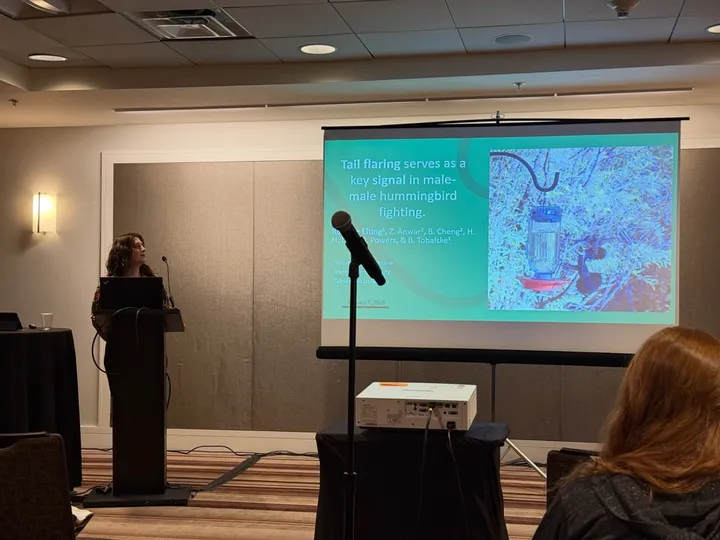
Rosalee Elting at the podium presenting her talk on tail flaring as a signal in male–male hummingbird fighting at SICB 2025

SICB has long been my favorite professional meeting. I first attended this meeting during my Ph.D. at UC Davis when it was held in San Francisco, CA. At that time it was called the American Society of Zoologists, but it changed its name to the Society for Integrative and Comparative Biology a few years later (what drove the name change is a really long story). As a young Ph.D. student it was invigorating to be completely immersed with people in my field. For years I also attended many bird-focused meetings, but over time began feeling like an outsider in societies that more and more were emphasizing pure ecology and applied studies.

This year in Atlanta was a lot of fun… mostly. This was the first SICB I have attended since my wife Theo and I moved to the east coast. We actually drove to Atlanta, making a bit of a road trip out of it (more on this later). Lab contributions to the meeting were the lowest in some time. Rosalee Elting, Bret Tobalske’s Ph.D. student and my former research student at George Fox University, gave a nice paper on tail flaring as a signal used by male hummingbirds when they are fighting. Last summer Bret and Rosalee took a trip to southeastern Arizona to collect high-speed video of fighting male hummingbirds. What they got was pretty amazing and beyond expectations. This will turn out to be a nice piece of Rosalee’s Ph.D. My involvement in this is somewhat peripheral, but still it’s exciting.

In addition to the great science I got to see at the meeting, it was also a time to renew a long-standing tradition Bret Tobalske and I have of finding a nice French restaurant and spending a little bit of money (well, maybe more than a little bit) on a great dinner and some great wines. Truth be told, we pull out all the stops. Heck, it’s once a year. The meeting also had its downer time as well. I made the decision to park my brand-new Ford F-150 (my wife’s retirement gift to me) in a lot a block away from the hotel to save a little money. A couple days into the meeting someone smashed in one of the rear windows and stole my nice Swarovski binoculars, which I had inadvertently left in the glove box. Thankfully they did not know to lift up the rear seat where my Kowa spotting scope was stored. They also took my stash of Diet Cokes that were in the back seat (if you know me, you know how much that hurt). In the end my insurance had my window repaired in a day, I moved my truck to the hotel underground lot, and all was good. It was expensive to replace my binoculars ($1,500 for new Nikons), but they are just things. Things can always be replaced.

I am enjoying being a scientist at my own pace in retirement (well, sort of retirement).
Calliope Hummingbird Energetics in Montana

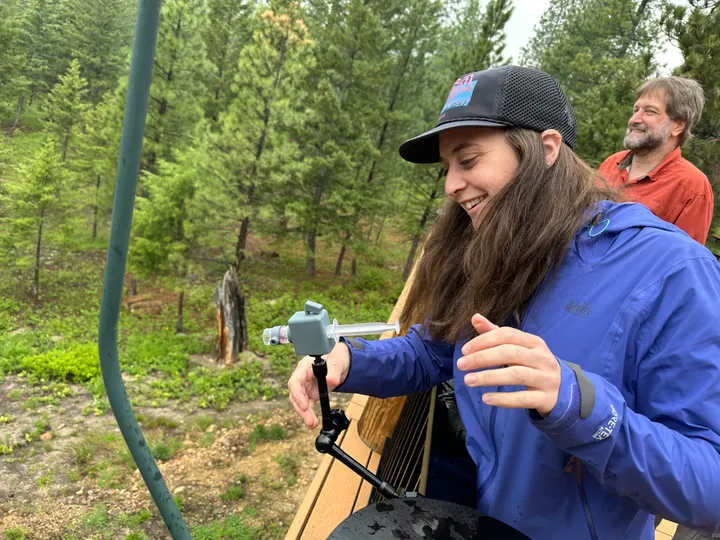
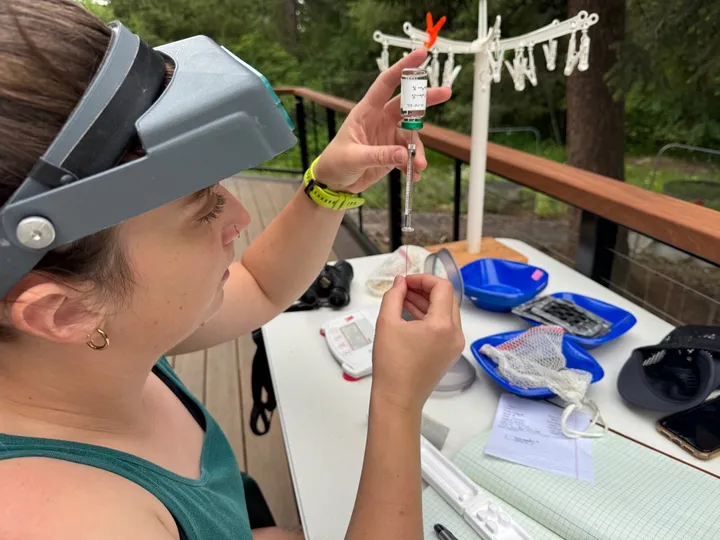
Rosalee Elting at an outdoor field table drawing doubly labeled water from a vial into a syringe

I was back for another field season at the University of Montana with my long-time collaborator Bret Tobalske. Bret and I have been collaborating since he started his academic career at the University of Portland many years ago. This year was a bit special because I got to work with my former research student Rosalee Elting, who is now one of Bret’s Ph.D. students. Rosalee is studying the energetics and biomechanics associated with hummingbird aggression. The focus this year was collection of energetics data on free-living male hummingbirds. We attempted to measure hovering metabolic rate at one field site and then to run a doubly labeled water (DLW) study at a second site. I have previously published studies using both these methods on free-living hummingbirds, but unexpectedly low bird numbers thwarted us this year. While having good energetics data on free-living birds where you have some idea of the social structure among males would have been nice, in the end we had to start thinking about designing experiments that could tackle energetic measurements in the lab. The questions that Rosalee wants to answer are quite ambitious, but in the end the answers to these questions can be an important contribution. Looking forward to getting back at it next year.

SICB in Seattle

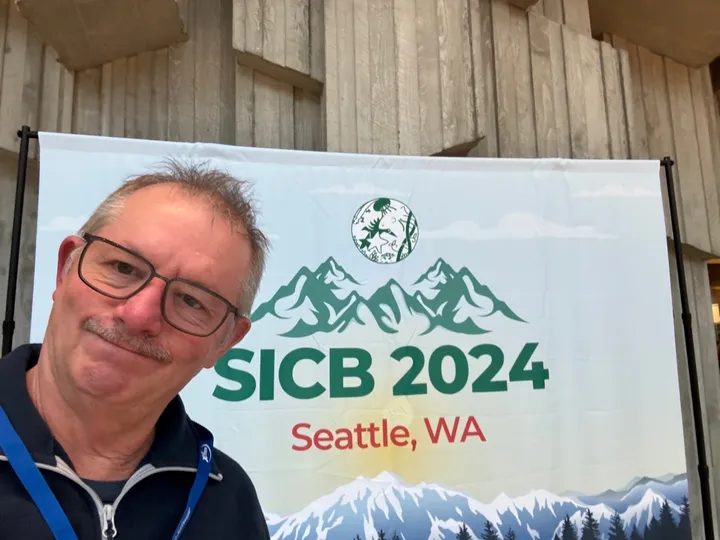
Don Powers in front of the SICB 2024 Seattle, WA welcome banner

This year the SICB meeting was held in Seattle, WA. The meeting was different this year in that it was the first time I attended without students. In prior years part of the student experience in my lab was preparing poster presentations of their hard work for presentation at this major professional meeting. After spending months crafting their posters, the meeting would be a relaxing time of celebration for the students as they immersed themselves for the first time in this sort of venue. This year, however, there was none of that. I attended the meeting with my wife Theo. The meeting was relaxing, and somewhat of a vacation. Even so, the lab was well represented. Collaborators Kris Crandell (Bangor University) gave a talk on Eurasian collared-dove heat dissipation and Rosalee Elting (University of Montana) gave a talk on aerial combat in hummingbirds. Watching Rosalee, a former research student in the lab, develop into a fine scientist has been a joy as well as a proud moment. I have no doubt that she will do great things down the road.

Off to the University of Montana!!

Researcher setting up a feeder on an outdoor flight arena in the Montana pines

Traveled to the University of Montana for my annual work with Bret Tobalske. This had an added bonus in that Bret took on Rosalee Elting, one of my former undergraduate researchers, as a Ph.D. student!

Our work this year would be several experiments associated with Rosalee’s Ph.D. work, including some novel competition studies of male calliope hummingbirds in a flight arena. To be honest, I thought it would be a challenge to get these competition trials to work, but in the end the success of this study was the highlight of my trip.

My concern for the competition experiment resulted from work I did for my Ph.D., where I tried to conduct competition trials in an outdoor tent in the Chiricahua Mts. Those experiments were not horribly successful and I was never able to get them published (tried hard). Even so, the experiments in Montana were a huge success, with calliope males battling each other to various degrees in all the trials. Was really fun to watch and look forward to Rosalee’s analysis of the data!

This was a very productive trip. Not only did we get some great competition videos, but we also got flight and load-lifting energetics data for all the birds in the study. We also set in motion experiments to get supportive data on free-living calliopes. Can’t wait to see what we learn from all these experiments.

Time to Retire

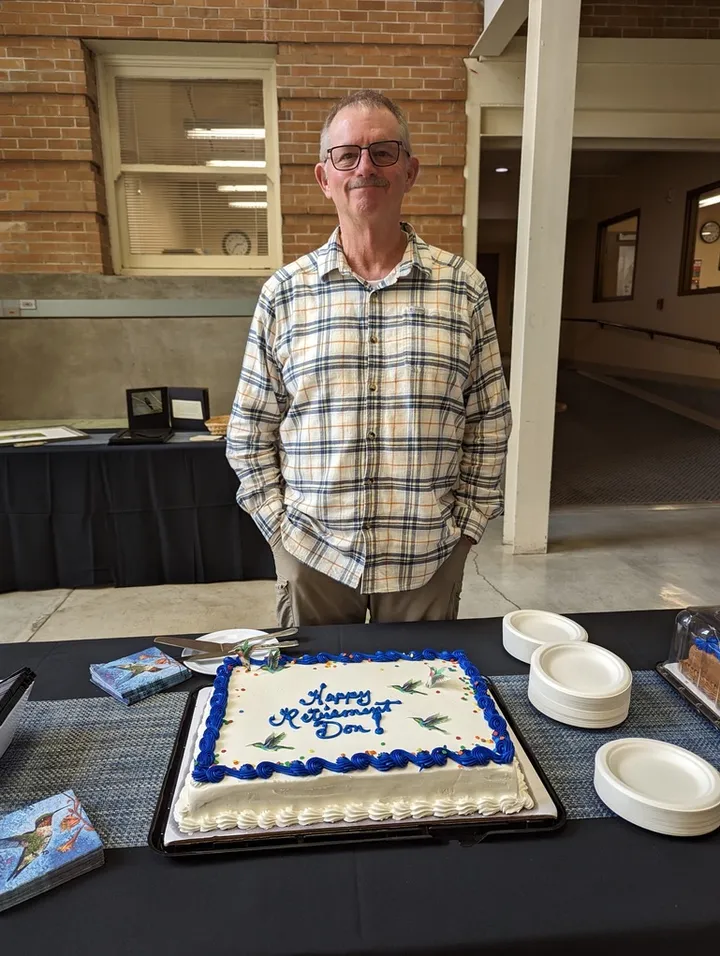
Don Powers standing behind a hummingbird-decorated ‘Happy Retirement Don!’ cake

After 34 years of teaching at George Fox University I have decided to retire. This is something I have been thinking about for some time, but last February I made the choice to pull the trigger. Many factors have gone into this decision, and I will not go into all of them here, but without a doubt now is the time. I have been blessed in so many ways the past 34 years. Since I first arrived here in 1989 I have had the opportunity to teach and mentor countless students, several of whom made the effort to come to and participate in my retirement celebration. It was humbling to listen to their stories of our encounters, some of which stretch clear back to my early years. While I have never had the opportunity to have official graduate students, I have had the joy and pleasure of working with 80–90 budding undergraduate scientists in my lab over the years who performed well beyond what anyone expected. Even though I set the bar high, without exception my students leapt well over it. Over the years I have had the opportunity to mentor a few graduate students at other institutions. Hopefully I was able to play a small part in their development as well.

So what is next? Even though I will no longer be in the classroom, the Powers Lab will go on. We might no longer have a physical location, but research is burned into my firmware. Science is what I do and will continue to do. Next month I will be off to Montana to continue my collaboration with Bret Tobalske and begin mentorship of a former Powers Lab student, Rosalee Elting, who has just started a Ph.D. in Bret’s lab. I will be moving to the east coast to be nearer family but will make regular trips back to the university to work with respirometry and stable isotope equipment that will continue to be housed there. So, I am not going away, but rather am just entering a new phase. Cheers!

Off to Austin and SICB!!!

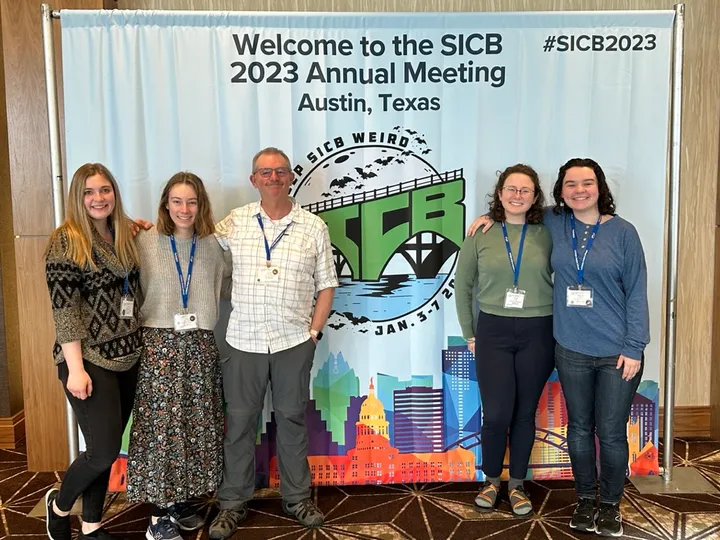
Kendra Wisenbaker, Emily Blackwell, Don Powers, Emma Ortiz and Whitney Dobbyn in front of the SICB 2023 Austin welcome banner

The lab wrapped up a successful year by heading off to Austin, TX and the SICB meeting to share what we had learned. SICB is the primary meeting we attend each year and serves as a wonderful opportunity for the students to strut their stuff, network, and gain international exposure.

The photo above is a team photo for all of us who attended the meeting. From left to right: Kendra Wisenbaker, Emily Blackwell, me, Emma Ortiz, and Whitney Dobbyn. All four students presented posters of portions of their work on hummingbirds from the past year. Emily presented her work linking body surface temperature and metabolic state, Whitney presented her work on the role plumage plays in restricting heat loss during flight, Kendra presented her work on post-flight heat dissipation from the perch in free-living hummingbirds, and Emma presented her work on thermal microclimates of perches selected by hummingbirds post flight. All the students did an amazing job! Normally I give a talk at this meeting but decided to take this year off. It was nice for a change to not have to think about a presentation.

Beyond the great science always presented at SICB, there were several other highlights from the meeting, including a wonderful symposium on heterothermy put together by Dr. Anusha Shankar and Dr. Ken Welch, catching up with old friends, some fun sightseeing, and the amazing food in Austin!

“Team Torpor” Joins the Lab for Work on Anna’s Hummingbird

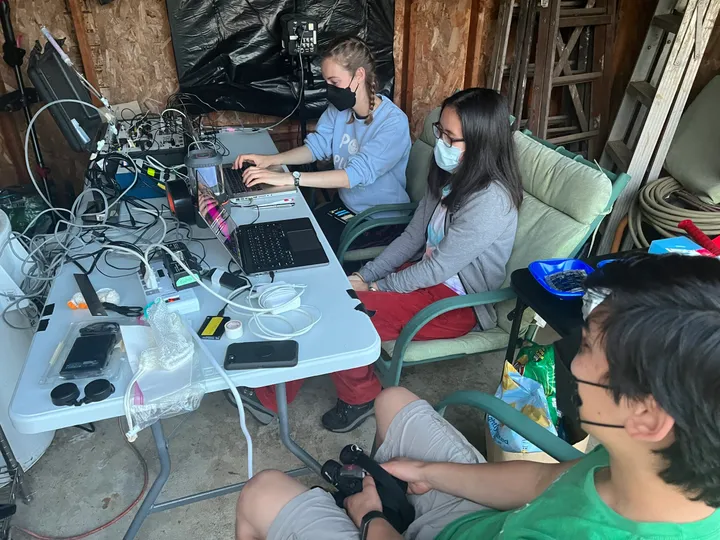
Three Team Torpor members working at laptops and equipment in the shed turned torpor lab

After completing their work in Arizona, “Team Torpor” transitioned to Oregon for a second year of work on Anna’s hummingbird during July. Collaborator Dr. Anusha Shankar, a Rose Postdoctoral Fellow at Cornell, joined us for this final leg of the torpor field work.

In addition to extending the work done in Arizona to the non-migratory Anna’s, Anusha was completing work started last year focused on understanding changes in gene expression associated with the use of torpor. For the entire month Anusha and the rest of the team (Emily, Sophia, Santi, and Shenni) turned my shed into a makeshift torpor lab!

The work involved data collection on birds at night, then preparation for molecular and histological work during the day. And, of course, Anusha always must fit time in for evening salsa dancing! It was a very busy month!

Off to the University of Guelph to Study the Impact of Keel Bone Damage on Laying Hens

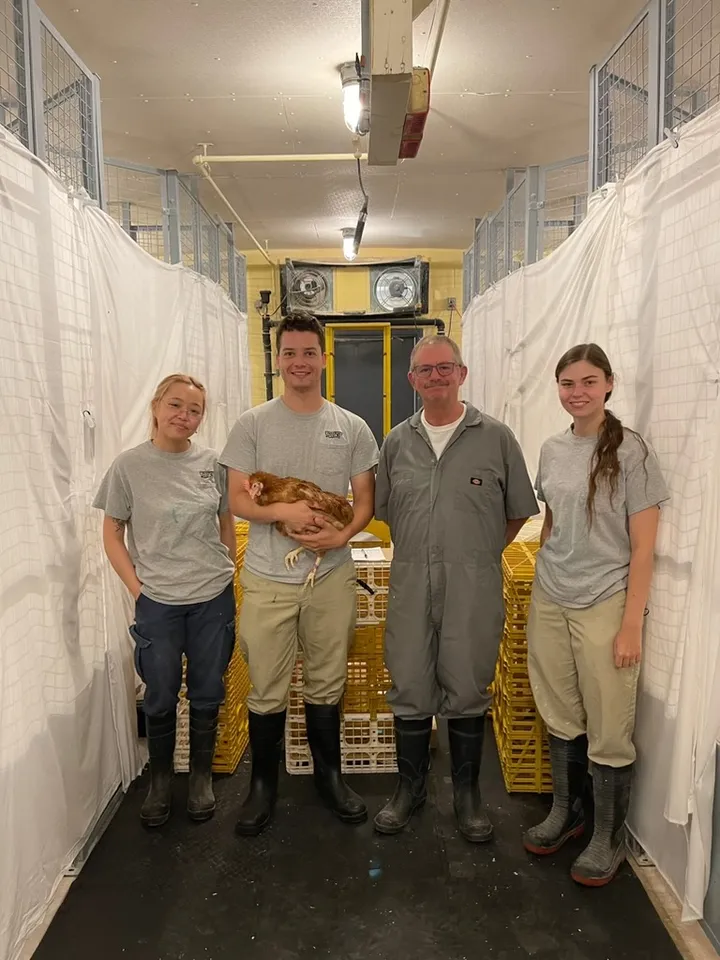
Don Powers and the Guelph team in protective gear in the hen barn, one holding a laying hen

The lab has been working with Dr. Alexandra Harlander at the University of Guelph for a few years in an effort to understand how keel bone damage (KBD) might impact energy costs in laying hens. This month was actually my first trip to Guelph to oversee a series of respirometry experiments organized by Jacob Brost, a master’s student in the Harlander lab.

This trip brought back multiple memories from my past. First, navigating Canadian customs with equipment is an adventure. I first learned this back in the days when I was working on garter snakes in Manitoba and had to spend an hour with customs explaining some small equipment items I was bringing home from the field for use in another project. It was no different this time around. I carried my small FoxBox (oxygen/CO2 analyzer) on the plane with me and was shuttled to three different customs officers who continually grilled me, thinking I was coming to Canada to illegally work. Eventually I passed muster, but it is not a fun experience. My second walk down memory lane was having to wear so much protective clothing when entering the buildings where the birds were housed. Reminded me of my days at UC Davis when everyone thought my hummingbirds were going to give all their turkeys and chickens deadly diseases.

During the week I was at Guelph we put the hens through their paces using mask respirometry to measure the cost of running and jumping, as well as resting metabolism. I will say that Jacob was very organized, with all experiments scheduled such that we would easily get things done. This included time for things not to work as planned, which was a good thing because we were delayed a day when my luggage, which contained necessary equipment, was lost by the airline.

In the end we got everything done on time and even had time to celebrate!